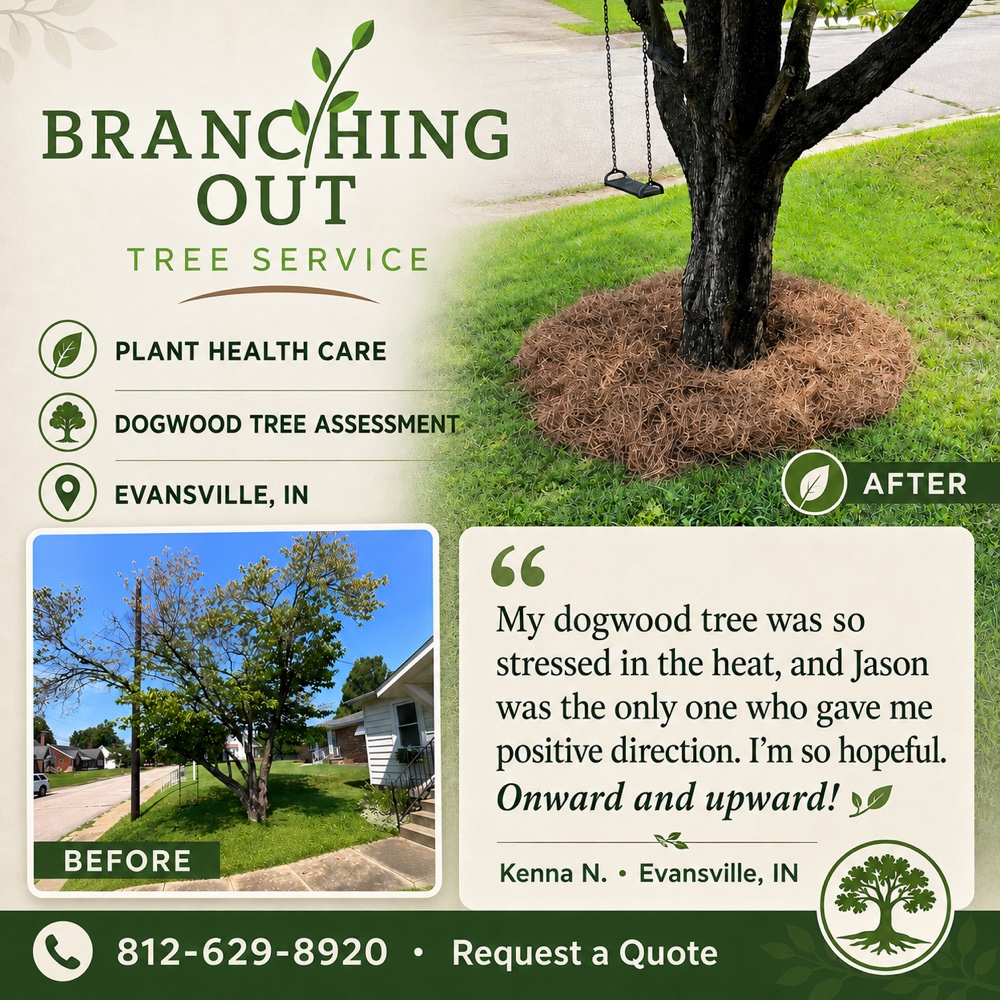
The homeowner was concerned about upper-canopy and tip dieback on a dogwood in a full-sun, exposed hilltop location. Those symptoms showed that the tree was under stress, but visible canopy decline alone could not identify the underlying cause.
The homeowner’s concern
The dogwood showed upper-canopy and tip dieback. Because similar canopy symptoms can develop from different site, root, pest, or structural problems, Branching Out performed a tree health assessment before recommending supportive care.
What the assessment found
The overall decline pattern was most consistent with chronic root-zone moisture and heat stress. Turf was competing with the feeder-root area, and the exposed hilltop site likely increased heat and moisture pressure. One dead lead showed signs consistent with dogwood borer activity, which was considered a likely secondary problem rather than necessarily the original cause of the broader decline.
The root-zone care plan
Deep-root irrigation was applied to the feeder-root area, followed by Root Revitalizer Pro as supportive root-zone care. The homeowner installed the recommended pine-straw mulch and received a deep-watering plan. Deadwood removal or pruning was recommended for the dormant season, with continued monitoring and reassessment if decline continues.
Why the root zone mattered
A stressed root system can reduce a tree’s ability to take up water and tolerate environmental pressure. That can also leave a tree less able to withstand secondary pest activity. This relationship supports the root-zone care plan, but it does not prove one single cause for every symptom.
Mulch and watering guidance
Apply approximately 2–3 inches of mulch over as much of the practical root zone as possible, while keeping it away from direct contact with the trunk and root collar. Water deeply and slowly based on rainfall and soil moisture. Avoid frequent shallow watering, and do not keep the root collar continually wet.
Care status and follow-up
The care plan has been implemented. The second condition shown in the project image documents that work—not confirmed canopy recovery. Root-zone care is supportive and is not a guaranteed cure; canopy response takes time, recovery is not guaranteed, and continued monitoring is appropriate.
Seeing dogwood canopy decline?
If you notice canopy thinning, tip dieback, premature leaf drop, or unexplained decline, call 812-629-8920 or request a tree assessment. Diagnosis should come before any treatment decision.
Request a Quote